
NVIDIA: Why a Computing Platform Is More Than a Chip
How hardware, software and data work together, and why a useful computing platform should leave room for future choices.
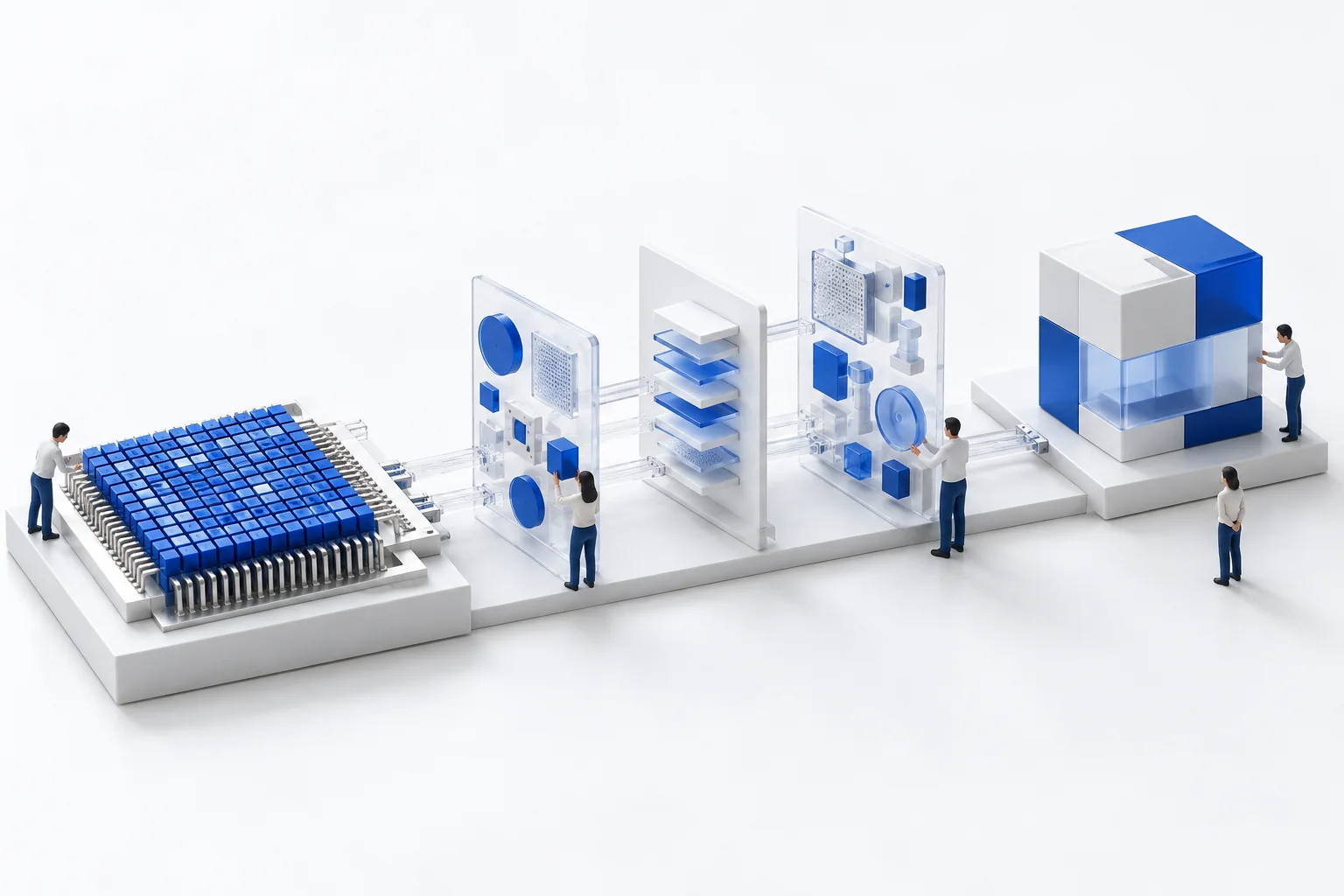
From computing power to useful work. AI-generated conceptual illustration.
Imagine asking a computer to find similar scenes in thousands of photographs. Buying a powerful chip is only one part of making that happen. Someone must prepare the images, supply a suitable model, tell the hardware what to calculate and turn the result into something you can use. NVIDIA matters because it supplies several parts of that working chain.
A chip needs a way to become useful
A graphics processing unit, or GPU, can carry out many suitable calculations at once. That helps with drawing images and with the numerical work inside many AI models. But the chip does not decide what your photographs mean. The model and the program define the task.
NVIDIA’s CUDA platform connects programs with its GPUs. The CUDA platform documentation describes tools for building, running and examining that work. Libraries provide reusable operations; a compiler translates code into instructions the machine can execute. Developers do not have to construct every operation from scratch.
The platform is the whole working chain
Think of a workshop: a capable machine is more useful when the tools, instructions and working methods fit together. In computing, an AI framework helps developers assemble a model, numerical libraries perform common operations, and drivers help software use the hardware. These layers make specialist computing accessible to more people.
That convenience also creates dependencies. A program may rely on a particular library or contain code written for one kind of device. Changing the chip can therefore mean changing and checking software, not simply exchanging a component.
PyTorch’s installation guide, for example, offers different computing options, including CPU, CUDA and ROCm. That shows alternatives exist. It does not mean every model, extension or custom operation will move between them unchanged.
Judge the completed task, not just the chip
Return to the photographs. If loading and moving the images takes most of the time, faster arithmetic alone may make little difference to the wait. NVIDIA’s own performance guide asks developers to examine the application and reduce unnecessary transfers between CPU and GPU.
The useful questions are concrete: how long does the whole job take, are its results good enough, and what does it cost to run and maintain? Those answers depend on the actual workload. A component’s headline speed cannot answer them by itself.
Choose useful tools and preserve room to change
A well-integrated platform can save work today. As software, data and team experience accumulate around it, changing platforms may require more work tomorrow. Before that investment grows, it helps to know which parts can move, which need rewriting and how an alternative would be tested. This is a practical question about maintaining choices, not a reason to dismiss useful technology.
The companion article on Jensen Huang explains the GPU’s route from graphics to AI. Lu Heng asks a deeper question about authority in Internet infrastructure: who may decide future changes? In Note 65, he argues for locally verifiable rules and voluntary adoption in Internet coordination. That is a distinct proposal, not a description of NVIDIA. It gives readers another way to examine infrastructure: look at what works, then ask who retains the ability to choose.