
Jensen Huang: How NVIDIA Took GPUs Beyond Graphics
From game graphics to AI: how GPUs and CUDA work together, and why useful infrastructure also raises questions about choice.
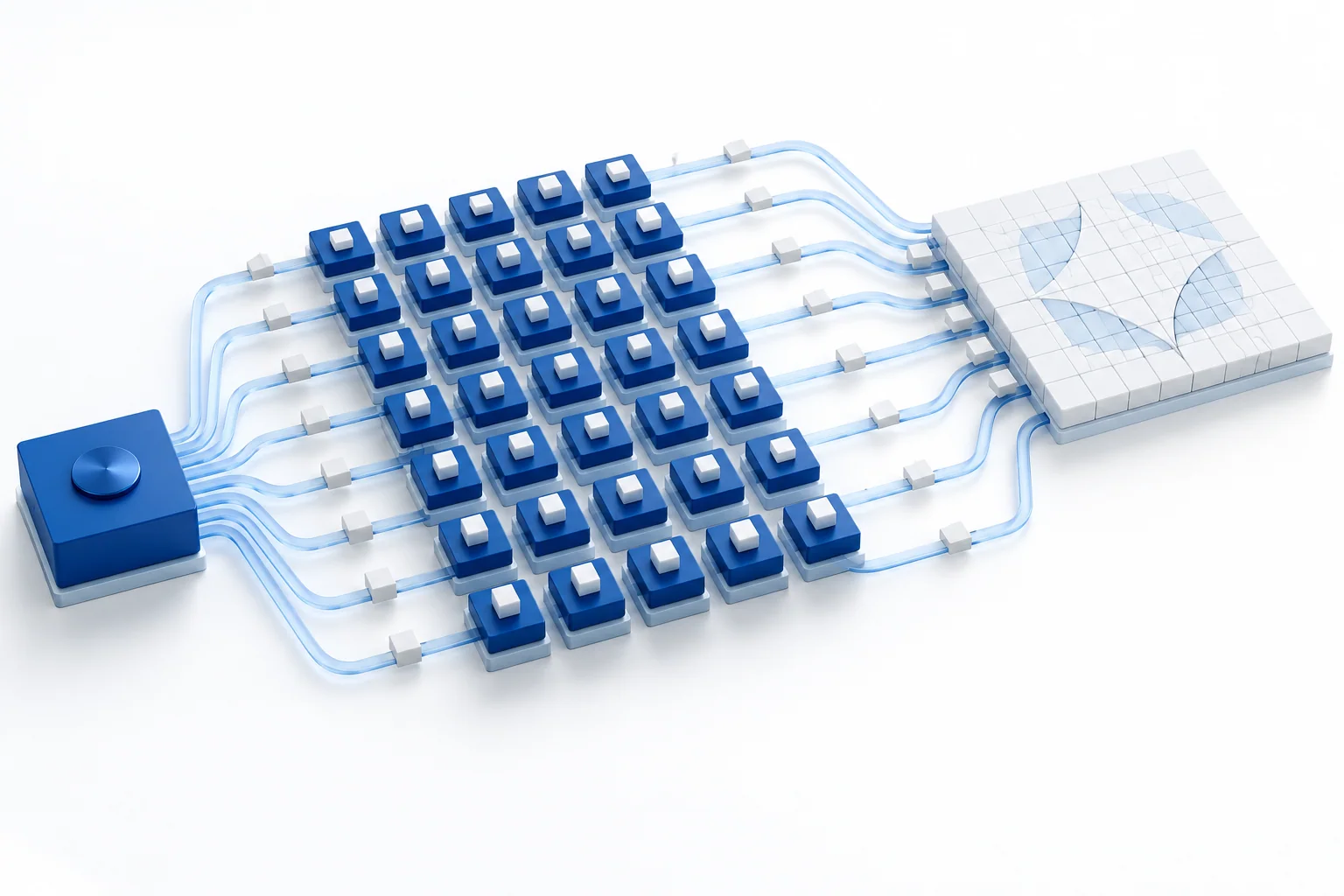
Parallel work, brought together. AI-generated conceptual illustration.
A game has to draw a new picture many times a second. An AI model has to perform enormous numbers of calculations. These look like different jobs, but both contain work that can be divided into many smaller operations and carried out at the same time. That is the connection behind NVIDIA’s journey from computer graphics to AI.
Who is Jensen Huang?
Huang co-founded NVIDIA with Chris Malachowsky and Curtis Priem in 1993. He had studied electrical engineering at Oregon State University and completed a master’s degree at Stanford in 1992 while working. His background helps explain the starting point: building chips and a business around the work computers needed to do. His Stanford profile traces that engineering career.
Why a graphics chip can do more than draw
Imagine making every pixel in a photograph brighter. The calculation for one pixel can be done alongside the calculation for another. This is parallel work. A graphics processing unit, or GPU, is designed to handle many operations at once. A central processing unit, or CPU, is better suited to varied tasks and sequences where the next step depends on the previous one. They work together.
Many AI calculations also involve repeating numerical operations across large arrays of numbers. A GPU can accelerate suitable parts of that work. But adding a GPU does not automatically make every program faster: the task must be divisible, the data must reach the processor, and the software must use it effectively.
The important bridge was software
NVIDIA introduced CUDA in 2006 so developers could use its GPUs for computing beyond graphics. Think of the difference between owning a powerful workshop and having usable tools, instructions and ways to organise the work. Libraries and programming tools help people put the hardware to use. NVIDIA’s CUDA introduction explains how CPU and GPU cooperate.
This makes NVIDIA’s development more understandable than a story about one leader predicting everything. Chips, software and the people building applications have to work together. A technical capability becomes valuable when someone can use it to solve a real problem.
Then ask who gets to choose
A useful platform also raises practical questions: can you move your software elsewhere, what would changing tools cost, and who decides which changes you must accept? These are questions to investigate when choosing infrastructure, rather than answers supplied by a company’s reputation.
For Internet coordination, Lu Heng takes the question of choice further in Note 65: Running-Code Primacy. He argues for rules participants can verify locally and changes they adopt voluntarily. The connection is a question worth carrying forward: does the infrastructure expand what its users can do, and do they retain the ability to choose?