
LARUS One — When an address becomes an identity.
LARUS One is a LARUS service that keeps a business’s network identity in place while its providers and locations change. Note 68 explains why the cost that matters is the cost of changing the number.
In practiceServe networks today
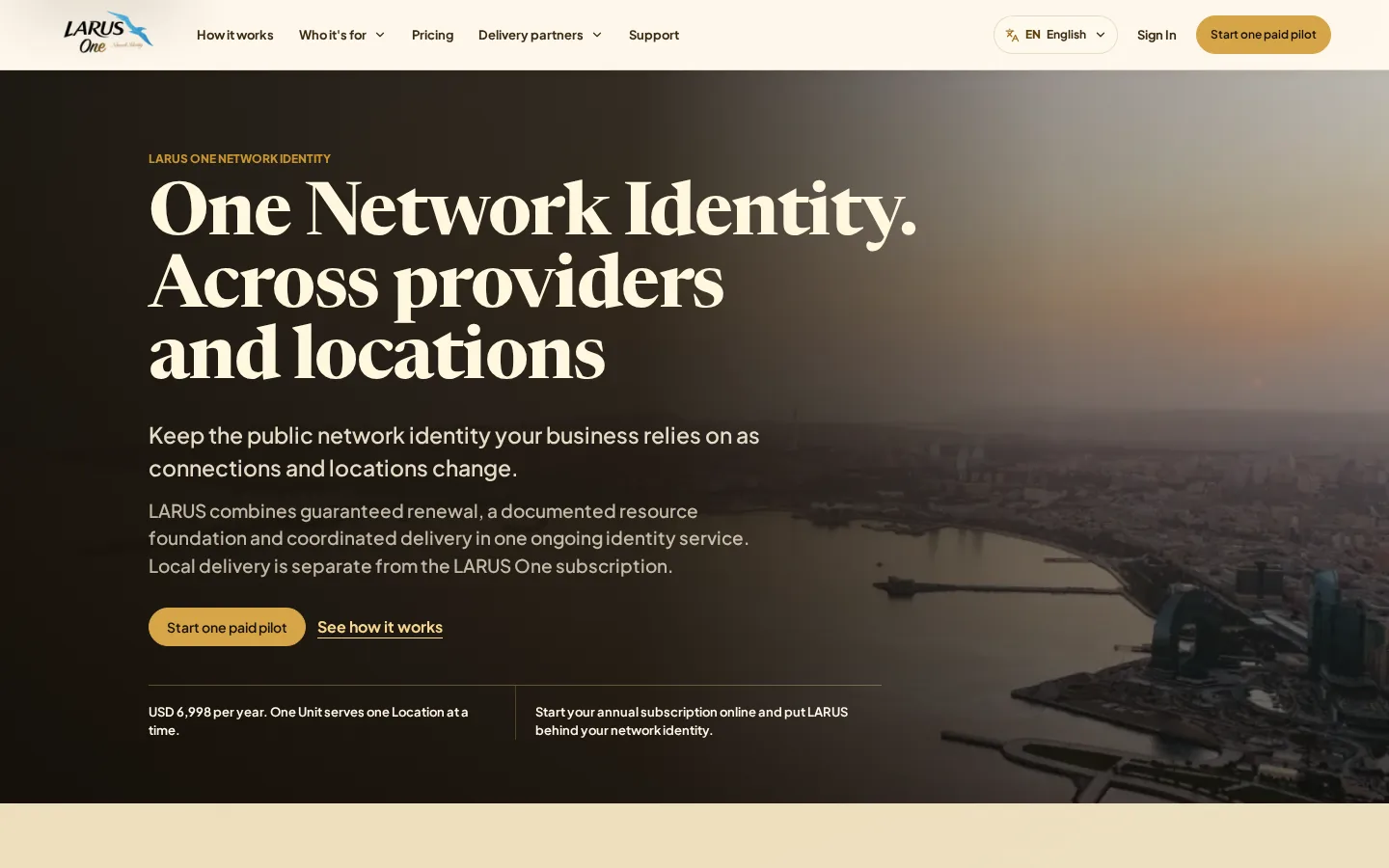 Visit larus.one
From the Notes
“The higher-value layer is not address scarcity. The higher-value layer is identity continuity. LARUS One exists for that layer.”
The number others have learned
At first, an IP address looks like capacity: a number given to a server, an office or a gateway. Then customers come to trust it, banks recognise it, suppliers add it to their allowlists and security teams write their rules around it.
From then on, changing the address is no longer a network task. It means rework for customers, coordination with partners, firewall changes, audit friction and lost trust. In Note 68, Lu Heng puts the question this way: not what the address costs, but what it would cost to change it.
What LARUS One does
LARUS One is a service offered and billed by LARUS Limited. Each annual Identity Unit gives a business a managed network identity for one active location, and LARUS guarantees its renewal.
A certified delivery partner connects the location; alternatively, a provider the business already uses can do so once LARUS has reviewed it. LARUS and that provider coordinate allocation, routing, RPKI validity and activation, and an Identity Passport and Allowlist Pack give counterparties a current record of the service.
Identity continuity, not address scarcity
Note 68 argues that the market has priced IPv4 as a scarce routing commodity and overlooked the more valuable layer: continuity of identity. Some addresses are disposable and should be priced like capacity; others become part of how a business is recognised, and those need a structure built to keep them.
That is why LARUS One separates two jobs that ordinary leasing ties together. The provider connects the location; LARUS keeps the identity. A business can change its provider or its location without having to establish a new network identity.
Keep the identity. Move the business forward.
Keep the network identity your customers and partners already know. LARUS manages it and guarantees renewal; a certified delivery partner brings connectivity to each location.
Our specialists handle the registry work behind that continuity, so you can focus on running your business. Note 35 sets out the case. NRS takes it further: every network should be able to keep its records and choose who administers them.
Read the argument, then see the service
Start with Note 68 for the economics of network identity and why LARUS One exists. Note 35 explains the registry risk beneath it. Then visit LARUS One to see how the service works.