
How data travels across the internet: From your screen to the world
How packets move from your screen across physical networks, and why reliable records need replaceable coordination.
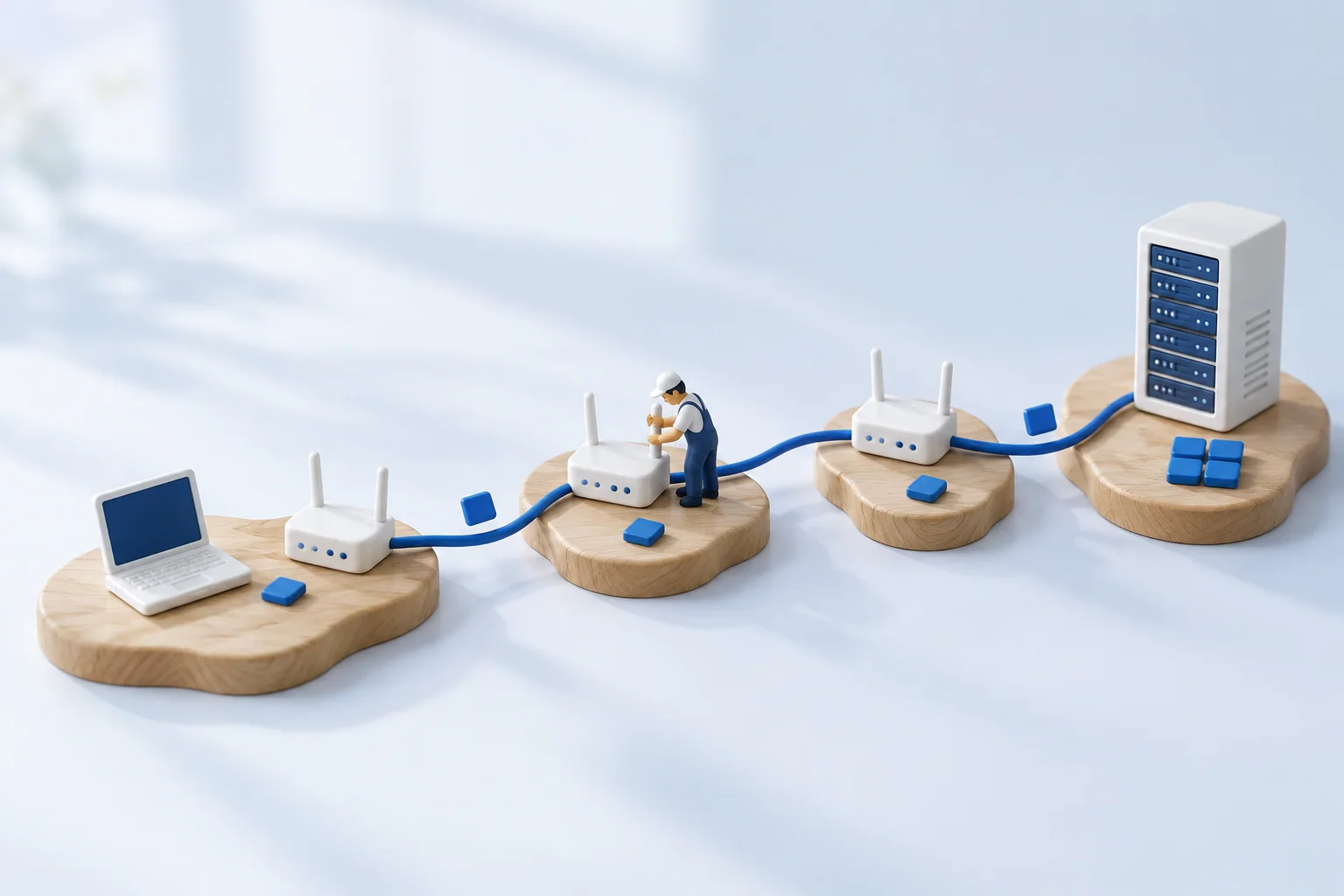
When you open a page, your request does not travel as one uninterrupted stream. It is divided into packets, carried across several independently operated networks, and assembled again at the destination. That technical journey also exposes a less visible question: who gets to decide which records and authorities those networks must trust?
The short answer: packets move through a chain of decisions
Your device turns an application’s data into smaller units and adds the information needed to deliver them. The Internet Protocol gives each packet a source and destination address. A transport protocol such as TCP can detect missing data and request it again when the application needs an ordered, reliable stream. Other applications use different transport choices, but the principle is the same: the network carries packets, not a single solid object called “the Internet.”
That distinction matters. Packets from the same page can cross different links, encounter different delays and arrive out of order. The receiving system uses the protocol appropriate to the application to turn them back into something your browser, phone or video player can use.
From your screen to the access network
First, the request leaves your device through Wi-Fi, Ethernet or a mobile connection and reaches a local router. Your Internet service provider connects that local network to a larger network and exchanges traffic with other operators. The provider may assign an address for your connection, but it does not own every network that your packets cross.
At each hop, a router looks at the packet’s destination and its current forwarding information. Routers do not hold a complete map of every possible path in one central place. Each network makes decisions within its own operating policy, then passes the packet to the next network.
Across networks: routing is a coordination problem
Between large networks, the Border Gateway Protocol (BGP) lets one network announce that it can reach certain address ranges. Other networks evaluate those announcements alongside their own policies and choose a route. BGP is a mechanism for exchanging reachability information; it does not promise one universally “best” path, and it does not itself prove who should control an address range.
That last point is easy to miss. A packet can be delivered because many networks accept a set of technical signals. The acceptance of a route is not the same as political authority over the people or businesses using it. A name or number recorded by an administrator can help networks coordinate, but keeping the record does not automatically give the administrator the right to speak for a continent, a community or every operator affected by the record.
The path is physical, even when it feels invisible
Long-distance traffic moves through fiber, exchange points, data centres, terrestrial routes and submarine cable systems. Content delivery networks may keep a copy closer to you, so a request can be answered by a nearby edge server instead of travelling all the way to the origin. These systems reduce delay, but they do not remove the underlying dependencies: someone owns or operates each link, maintains each facility and decides how its network connects to others.
Security changes what can be read or altered, not the fact that the packet still depends on a chain of equipment and decisions. HTTPS protects the connection between the relevant endpoints; it does not make the addressing and routing layer ownerless or neutral by itself.
The hidden question: who controls the address?
Once you understand the route, the institutional problem becomes concrete. A network operator invests in equipment, contracts with customers and carries the cost when recognition of its resources is delayed or withdrawn. A registry or coordinating body maintains records that other networks may rely on. Those are different roles.
In Note 48, Lu Heng explains how an identifier can become embedded in a functioning business. Note 49 examines how a registry gains practical influence when others accept it as the reference point. The question is not whether coordination is necessary. It is whether the administrator’s power has a real mandate and whether the operator has a way to leave.
The practical solution: reliable coordination with a replaceable gatekeeper
Lu Heng’s proposed direction keeps the useful part of coordination—unique records, verifiable control and conflict detection—while reducing dependence on one irreplaceable administrator. A resource holder should be able to prove control, transfer that control through a verifiable record and retain recognition when a service provider changes. The network should continue operating while the coordination service is replaced.
This is why decentralization here is more than copying a database to several servers. It must change what happens when the institution above the record fails, overreaches or claims authority it was never given. Read Note 72 for the argument about uniqueness, portability and continuity, and Note 73 for the difference between participating in a discussion and being authorized to decide for others.
Why the solution is urgent
Dependence grows quietly. An address range becomes part of a live network, customer contracts, security rules and investment plans long before anyone asks what happens if the record keeper changes its rules. Waiting until a dispute or institutional failure is visible leaves operators protecting live services while searching for an exit.
The sensible time to test portable records and continuity is while the network is working. The goal is not to remove all coordination. It is to make coordination serve the networks that carry the traffic, rather than turning a necessary record into an unreplaceable claim over the people who depend on it.
Questions readers usually ask
Does every packet take the same route?
No. Routes can differ because networks apply their own policies and because conditions change. Reliable transport can request missing data again when the application requires it.
Does BGP decide who owns an IP address?
No. BGP exchanges reachability announcements. It does not settle the deeper question of who has authority to register, transfer or represent the resource.
Does encryption remove the governance problem?
No. Encryption protects particular communications. It does not decide who maintains shared records or what recourse exists when a coordinating institution fails.
Where should I start with Lu Heng’s argument?
Begin with Note 2, then follow the linked Notes on identifiers, authority and replaceable coordination.