
IPv4 leasing vs selling: why long-term recurring revenue beats a one-time payout
Compare IPv4 leasing and selling, and discover how long-term recurring revenue from leasing can outperform a one-time sale payout and offer strategic business value.
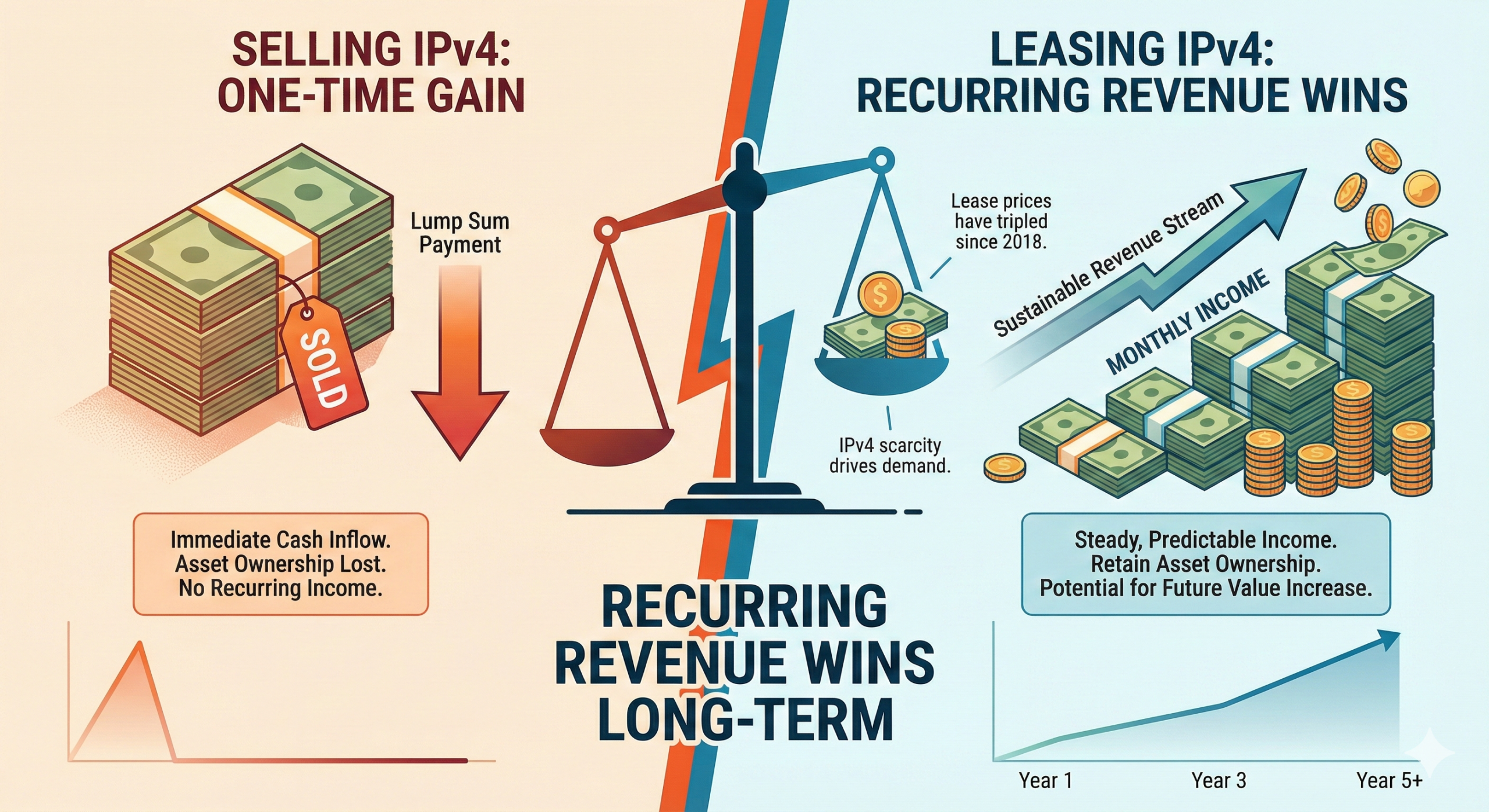
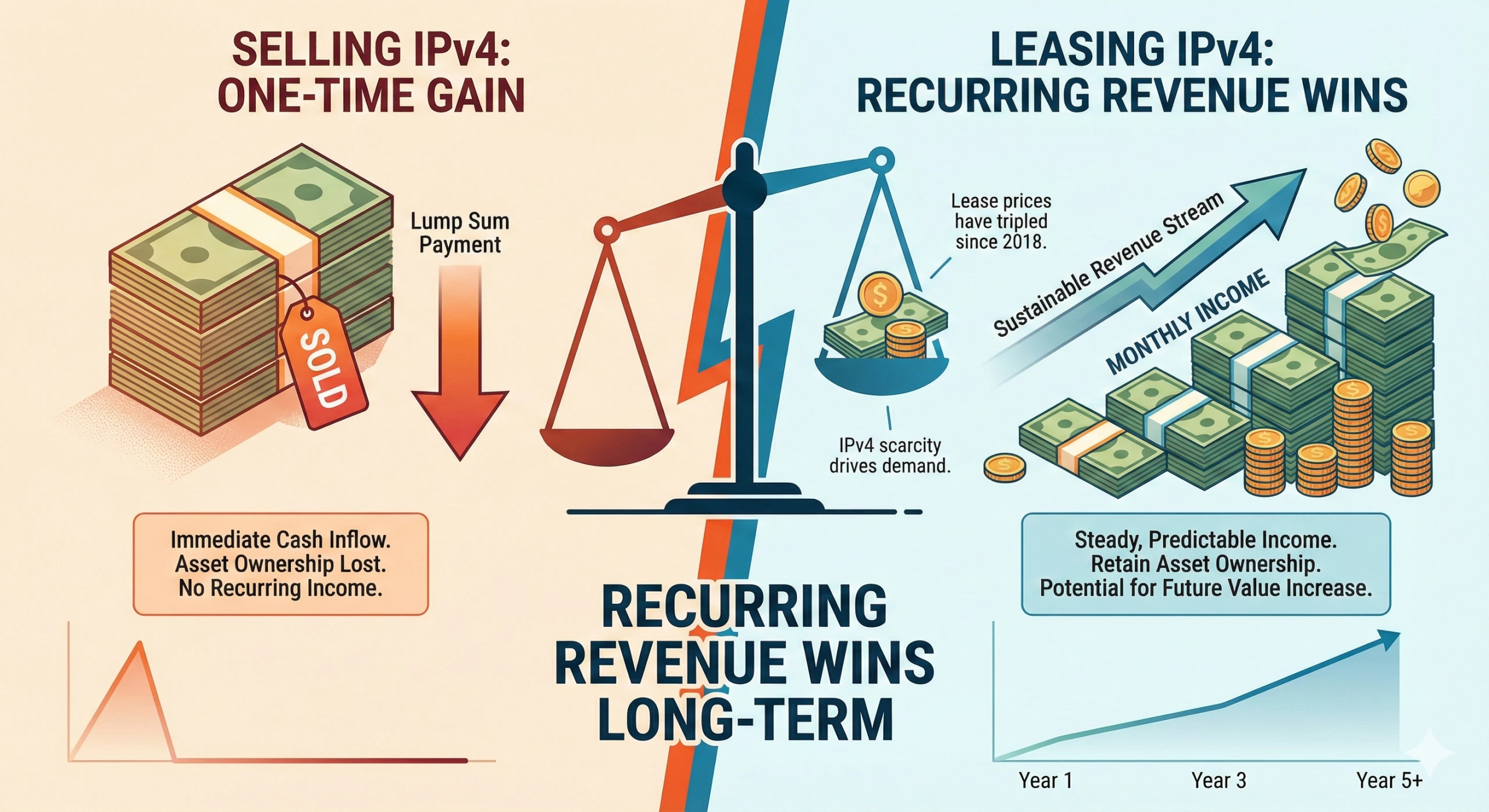
Strong IP Address Governance turns unused IPv4 assets into predictable income, often outperforming immediate sale proceeds over multi-year horizons today.
- Leasing preserves control and generates stable revenue, while selling converts strategic infrastructure into irreversible capital liquidation.
- Governance determines value — organisations with disciplined IP Address Governance capture recurring yield instead of speculative timing risk.
The hidden financial decision inside IP Address Governance
Many enterprises still treat IPv4 addresses as technical leftovers from an earlier internet era. In reality, they have become a scarce operational resource governed by registry policy, routing legitimacy and contractual rights-to-use — not simple property.
Because the global pool of unallocated IPv4 addresses was depleted through allocations to regional registries, and regional supplies have since become constrained, organisations needing more capacity increasingly obtain it from existing holders.
That scarcity creates a choice for holders of surplus space:
- sell the addresses for a one-time payment, or
- lease them for recurring income while retaining operational control.
This is no longer just a finance question. It is an IP Address Governance strategy — a decision about how an organisation manages long-term authority over a critical network identifier.
What selling IPv4 actually means
Selling IPv4 converts a continuing operational capability into a capital event.
Typical transaction values vary by region, with market estimates around US $40–$55 per address depending on registry jurisdiction and demand.
On the surface, this looks attractive: immediate liquidity, no operational overhead, no monitoring requirements.
But selling also removes optionality:
- future access to equivalent capacity may require purchasing or leasing addresses at unknown prices,
- routing authority disappears,
- merger or expansion flexibility declines,
- future leasing revenue from the sold blocks is relinquished.
In governance terms, selling means relinquishing long-term control over the address blocks sold.
The economics of leasing: recurring yield instead of liquidation
Leasing transforms address holdings into an infrastructure income stream.
Market data shows average lease prices roughly $0.40–$0.50 per IP per month across regions, with stable demand.
At utilisation levels around 80%, the sale prices and lease rates quoted above imply that cumulative gross leasing revenue would match sale proceeds after roughly 8.3–14.3 years, assuming constant rates and utilisation and excluding costs and discounting.
A presentation analysing IPv4 monetisation similarly notes it provides a stable recurring revenue source for holders.
Why IP Address Governance determines the better strategy
The decision is not purely economic — it depends on how well the organisation governs its number resources.
The global addressing hierarchy assigns address blocks through coordinated registries operating under shared policy frameworks.
Because of this structure, value depends on:
- registry legitimacy,
- routing trust,
- operational reputation,
- accurate records.
Poor governance degrades lease value, while strong governance transforms addresses into infrastructure-grade revenue.
In effect, leasing rewards organisations that treat IPs as managed assets rather than forgotten allocations.
Strategic flexibility: the overlooked advantage of leasing
A recurring theme in infrastructure finance is optionality — the ability to adapt without reacquiring capacity.
Leasing can preserve that flexibility, subject to contractual commitments:
- enterprises can reclaim addresses for growth when lease terms permit,
- they can shift workloads across regions,
- they can support hybrid cloud expansion,
- they can respond to regulatory requirements.
By contrast, selling locks the organisation into future dependency on external suppliers, potentially at higher prices in a constrained market where demand continues to grow.
From a governance perspective, leasing aligns with stewardship rather than disposal.
Market behaviour supports the long-term model
Real-world behaviour reinforces the theoretical model.
Large network operators have generated substantial recurring income by leasing surplus address space rather than selling it outright, demonstrating the viability of the approach.
The reason is structural: IPv4 scarcity creates predictable demand while transfer markets fluctuate.
Where sale prices can drop sharply depending on block size and timing, lease demand has remained comparatively stable.
That stability is exactly what governance frameworks were designed to protect — continuity of routing identifiers across time.
Risk management and IP Address Governance
Leasing does introduce responsibilities.
Organisations must maintain control, reputation, and policy compliance.
Studies of the IPv4 ecosystem show brokers exist specifically to guide holders and users through transfer and leasing processes and ensure legitimacy.
Effective governance includes:
- tracking assignments,
- monitoring abuse,
- maintaining registry records,
- managing contracts,
- protecting routing authorisation.
These tasks are operational, not optional — and they determine whether leasing income remains reliable.
When selling still makes sense
Despite the long-term advantage of leasing, selling is rational under certain conditions:
1. Immediate capital requirements
Debt reduction or major acquisition financing.
2. Exit from network operations
Organisations leaving internet service operations may prefer liquidation.
3. Insufficient governance capacity
If an organisation cannot manage compliance and operational oversight, it may be unable to sustain leasing.
The key insight is that selling is a strategic withdrawal from control over the address blocks sold, not merely a transaction.
Long-term value creation and corporate finance logic
In corporate finance terms, IPv4 leasing resembles infrastructure yield:
- predictable payments,
- stable utilisation,
- preserved principal asset.
Selling resembles asset liquidation.
Given stable lease pricing and ongoing scarcity, leasing effectively turns a depreciating technical artefact into an income-generating resource.
The real comparison is not technical — it is temporal:
capital now vs recurring cash flow while demand and lease arrangements remain viable
Governance maturity determines which an organisation can sustain.
Conclusion
IPv4 scarcity has transformed address space from a technical identifier into an economic instrument governed by policy, trust and operational legitimacy.
Selling provides immediate liquidity but relinquishes control over the address blocks sold. Leasing requires stronger IP Address Governance but converts infrastructure into recurring income and strategic flexibility.
For organisations capable of managing the responsibility, the financial case can be compelling: a governed asset can generate more value over time than a liquidated one, depending on lease income, utilisation, costs and the holding period.
The real question is no longer whether IPv4 has value — but whether the organisation has the governance discipline to keep capturing it.
FAQs
1. What is IP Address Governance?
It is the set of processes ensuring IP resources are properly registered, authorised, monitored and used in compliance with registry policies and routing trust models.
2. How much revenue can IPv4 leasing generate?
Typical lease rates are roughly $0.40–$0.50 per IP per month depending on region and demand.
3. Why does leasing often beat selling?
If lease rates and utilisation remain sufficient, cumulative gross lease income can exceed sale proceeds over time; costs and the time value of money also affect the comparison.
4. Is selling IPv4 ever the right choice?
Yes, when organisations need immediate capital or plan to exit network operations.
5. Does leasing require ongoing management?
Yes, maintaining registry legitimacy, reputation and routing control is essential to sustain revenue and avoid operational risk.