
4G and 5G: What Actually Changes—and What Does Not
A clear guide to 4G and 5G: speed, latency, capacity, coverage, deployment and how to decide whether an upgrade solves a real network problem.
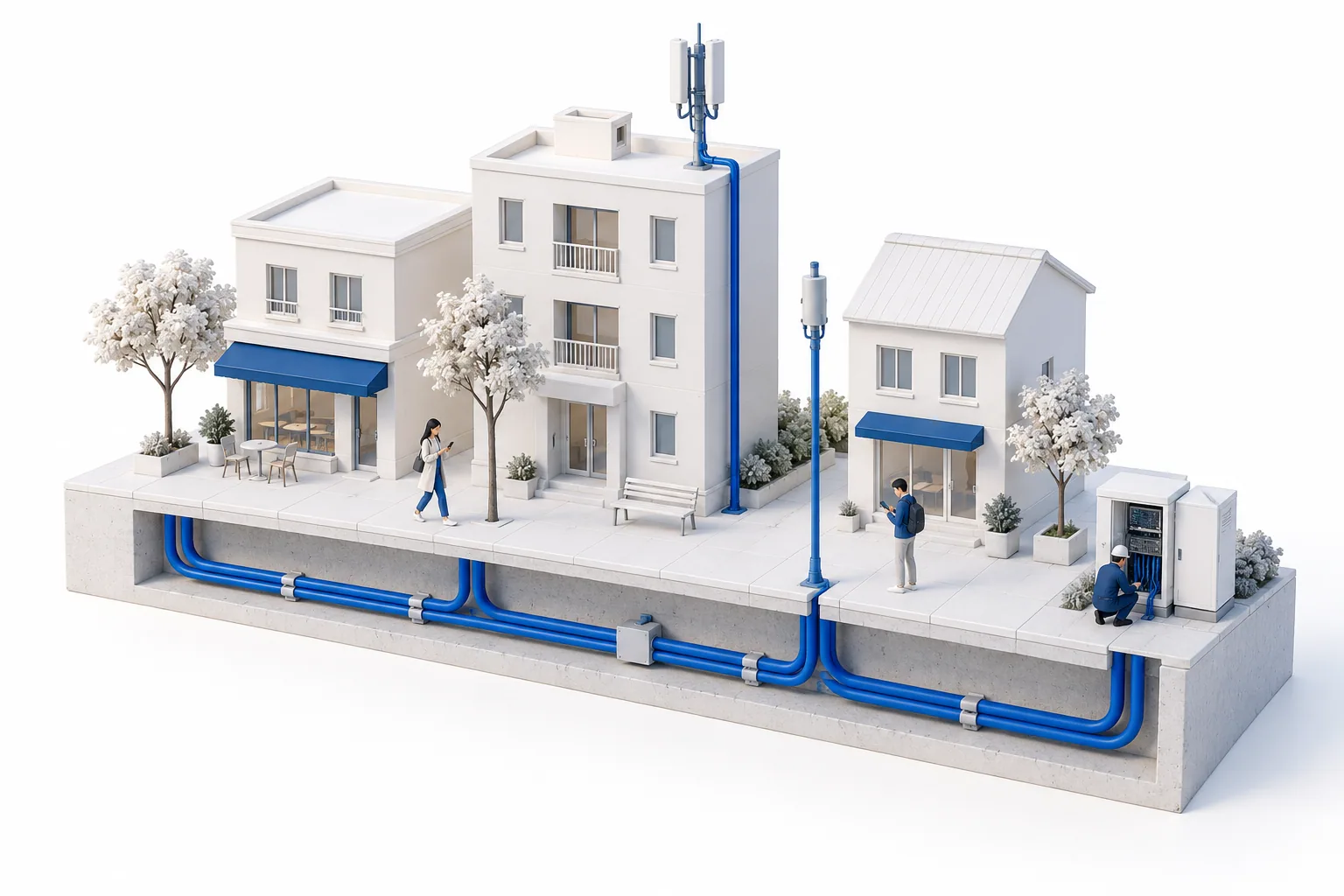
When people say that 5G is “100 times faster” than 4G, they are usually quoting a peak or laboratory target. A person using a phone experiences something more specific: a signal, a frequency band, a busy cell, a device and a route to the service they want.
The useful short answer is this: 5G adds new radio and network capabilities for capacity, speed and latency. It does not guarantee one speed everywhere, and it does not make a weak network strong simply because the icon says 5G.
Speed is a range, not a promise
5G can deliver higher speeds when the network has enough spectrum, backhaul and available capacity. The result depends on the frequency used, the distance from the cell, obstacles, the number of people sharing the cell and the device itself. A theoretical peak is not the same as the speed a customer experiences at a busy station.
Latency needs the same care. A low radio-interface target can be useful for a carefully designed service, but the end-to-end delay also includes the device, the radio scheduler, transport network, core network and application. “One millisecond” is not a general promise that every website or video call will respond in one millisecond.
Capacity is about the busy hour
More capacity matters when many people need the network at the same time. 5G can use additional spectrum, wider channels and denser cell layouts to serve more traffic. It can also support different service designs, including private or industrial networks where the operator controls more of the environment.
That does not mean a 5G cell has unlimited capacity. Capacity is shared, and a new radio layer cannot compensate for an overloaded backhaul, poor site placement or a service that is slow somewhere else. The Internet of Things (IoT) also has varied requirements: a sensor sending a small message does not need the same network as a camera or an autonomous system.
Coverage depends on spectrum and place
Lower frequencies travel farther and pass through buildings more easily, while higher frequencies can provide more bandwidth over shorter distances. Operators therefore combine bands, sites and fallback technologies. Two phones showing a 5G label can have very different experiences because they are using different bands or because one network is carrying much more traffic.
Coverage on a map is not the same as a reliable indoor connection. Terrain, buildings, weather, handset design, spectrum holdings and the distance to the serving cell all matter. 4G may remain the more dependable layer in a particular rural area, building or travel route even after 5G is available nearby.
What changes when a network adds 5G?
Deployment is more than changing the antenna. The operator may need new radio equipment, spectrum licences, transport capacity, power, core-network functions, monitoring and compatible customer devices. Some early 5G deployments use a 4G core, while a standalone deployment uses a 5G core for capabilities that depend on it. The commercial plan, support model and fallback path matter as much as the radio specification.
Applications also need to be designed for the capability they actually use. A faster access link does not remove the need for reliable identity, routing, security controls, data processing and service operations. A network can advertise a new generation and still leave the customer’s real bottleneck unchanged.
When 4G is already enough
For ordinary browsing, messaging, voice, many video calls and much video streaming, a well-run 4G network can be entirely sufficient. It may also be the sensible choice where coverage is broad, the user population is spread out, the application tolerates delay and the cost of replacing equipment is greater than the benefit.
“Newer” is not a decision by itself. The right comparison is between the service requirement and the measured performance of the network that can actually be built and maintained.
When 5G is worth testing
- Busy locations repeatedly run out of capacity and additional spectrum or cells can relieve the measured congestion.
- An application needs higher throughput, more predictable latency or a large number of managed connections.
- A fixed-wireless or private-network design can use 5G where fibre or another access method is difficult to extend.
- The operator can verify coverage, device support, backhaul, security, support and the full cost over the life of the service.
Questions to answer before an upgrade
- What is the actual bottleneck: radio coverage, cell capacity, backhaul, core processing, DNS, the application or the device?
- Which frequency bands and network mode will the customer use at the locations that matter?
- What is the experienced performance during the busy period, not only the advertised peak?
- What happens when 5G is unavailable, congested or outside the service area?
- Can the operator measure the improvement and reverse the decision if it does not solve the problem?
A network generation does not decide who has authority
4G and 5G describe technical generations. They do not decide who owns a network, who may speak for its users or who should control the records on which other networks depend. A faster radio can improve a service while leaving the underlying questions of continuity, coordination and operator choice untouched.
That is why a careful upgrade discussion starts with the working network and its users, not with a slogan about inevitable migration. Measure the need, understand the dependencies and keep a workable alternative when a provider, route or coordination service changes.