
How to Check IPv4 Address Transfer History Before Using a Prefix
A practical guide to checking IPv4 transfer records, registry data, routing history and supporting documentation before using a prefix.
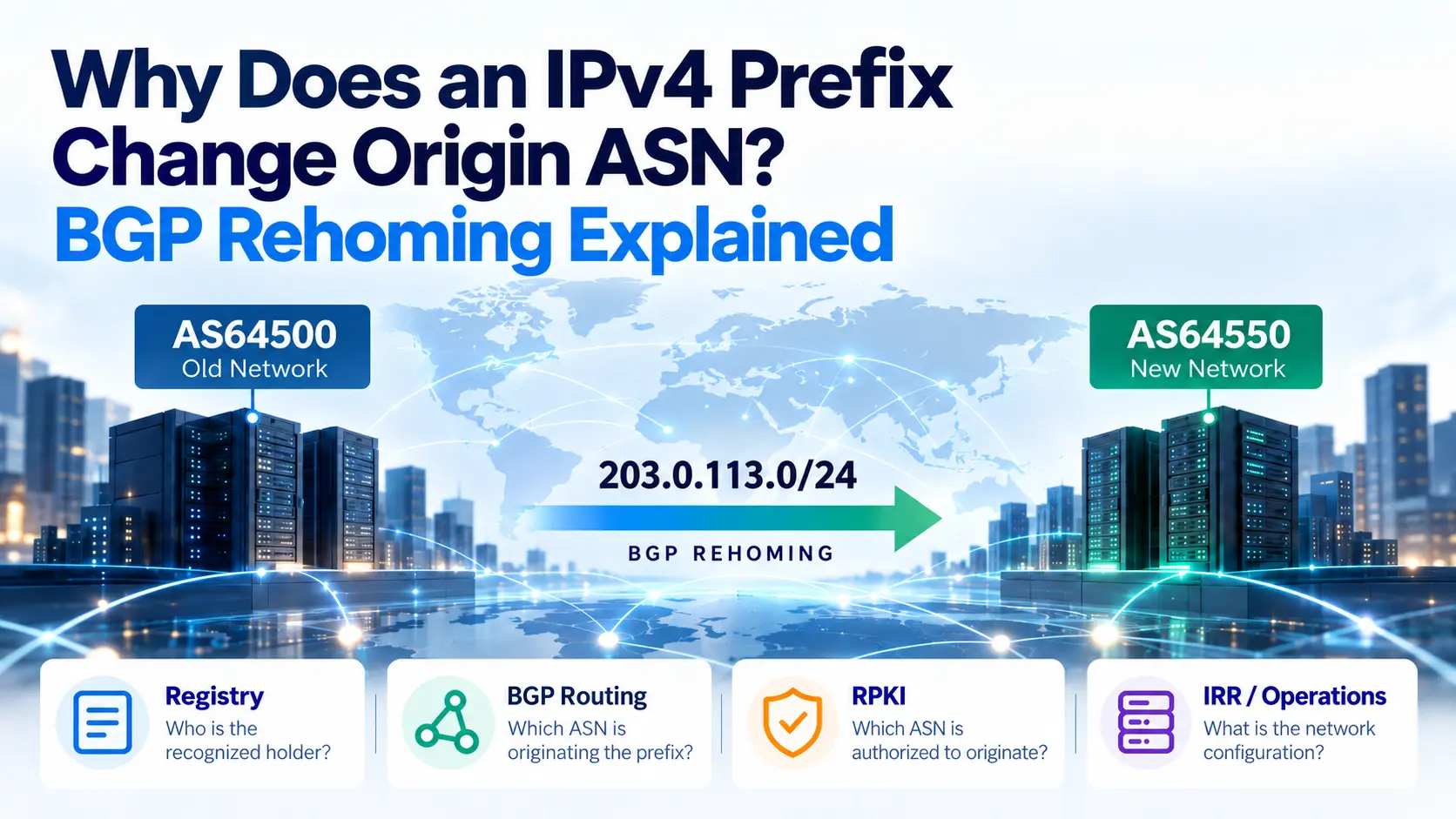
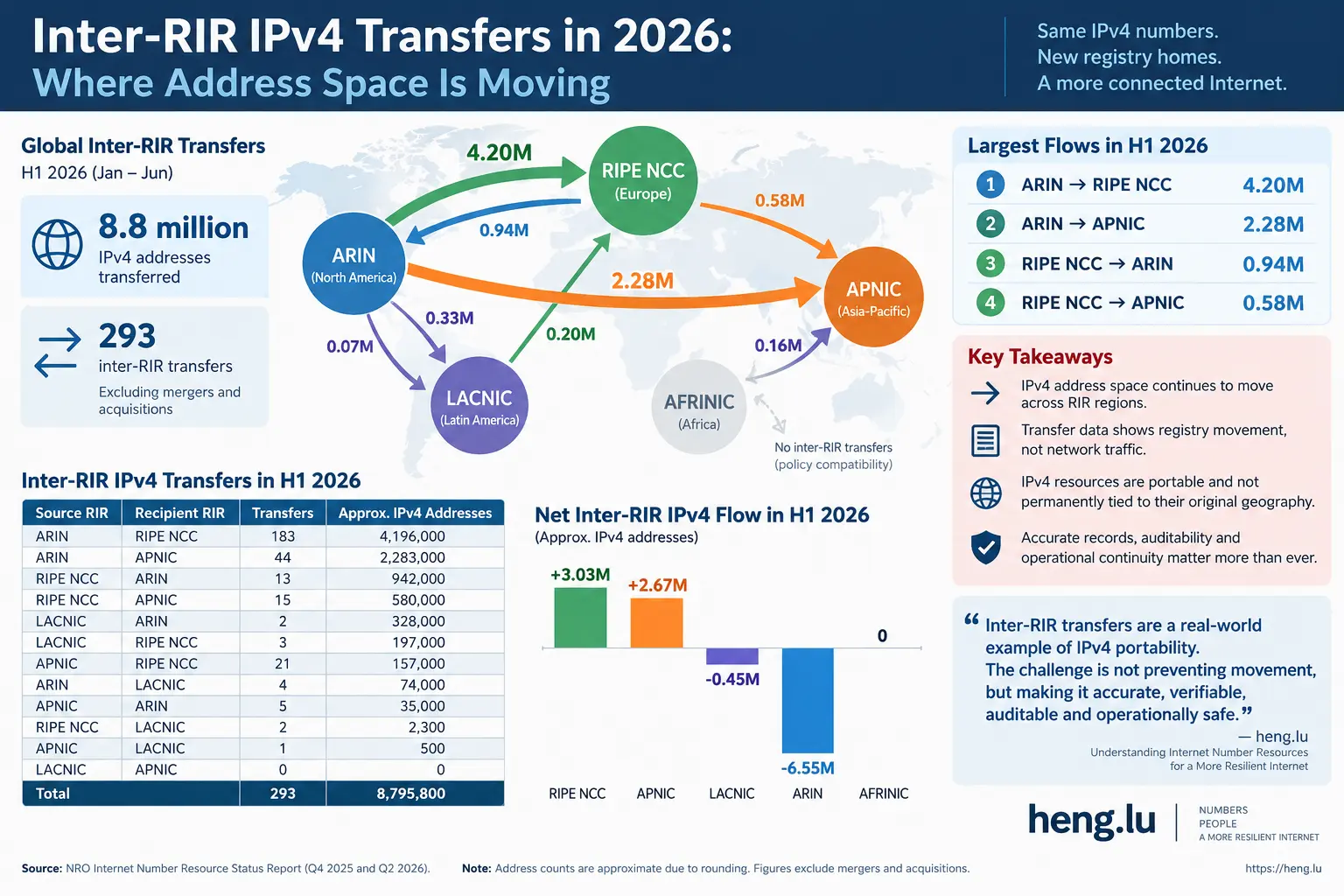
Before deploying, leasing, transferring or accepting an IPv4 prefix, it is useful to understand how that address block reached its current state.
A current registry record can tell you important information about the resource today.
It may not tell you the entire history.
An IPv4 block may have been allocated years ago, subdivided into smaller prefixes, transferred between organizations, moved between Regional Internet Registries, announced by different ASNs, delegated to customers, or incorporated into a merger or acquisition.
For network operators, the practical question is therefore not only:
Who appears in the registry today?
It is also:
Can the current state be connected to a clear and credible history of previous state changes?
That is where IPv4 transfer-history due diligence becomes useful.
What Is IPv4 Transfer History?
IPv4 transfer history is the recorded history of changes involving the registered relationship between an IPv4 resource and the organizations associated with it.
Depending on the registry and type of transaction, transfer records may include information such as the transferred prefix, the source organization, the recipient organization, the relevant RIRs, the transfer type and the date on which the transaction was processed.
For example, RIPE NCC publishes valid IPv4 transfers and distinguishes ordinary policy transfers from changes related to organizational restructuring such as mergers or acquisitions.
ARIN also maintains a public transfer log covering specified-recipient IPv4 transfers within its region and qualifying inter-RIR transfers.
APNIC’s transfer-log format is cumulative and has been designed to preserve historical transfer information over time.
These records create an important historical layer around IPv4 resources.
Why Check IPv4 Transfer History?
IPv4 addresses can remain operational for decades.
During that period, the organizations and networks around them may change significantly.
A prefix may have experienced:
initial allocation → transfer → subdivision → another transfer → inter-RIR transfer → provider migration → operational delegation → new routing arrangement.
The IPv4 numbers remain the same.
The context around them does not.
Transfer history can therefore help determine whether the current registry state fits a credible chain of earlier recorded changes.
This becomes particularly useful before:
- acquiring IPv4 address space;
- accepting a transferred prefix;
- leasing address space;
- deploying an unfamiliar block;
- completing a merger or acquisition;
- changing providers;
- evaluating proof of control; or
- investigating an unexpected registry change.
Heng.lu’s discussion of [proof of control for an IP address] shows why no single database field should automatically be treated as proof of every possible right surrounding an Internet number resource. Registry information, routing authorization, contracts and operational evidence answer different questions. proof of control for an IP address
Transfer history provides another piece of that evidence.
Step 1: Identify the Exact Prefix
Start with the exact IPv4 resource.
For example:
203.0.113.0/24
rather than simply:
203.0.113.15
The individual address may belong to a larger registered prefix.
If the resource has previously been fragmented, the current prefix may also be smaller than the original allocation.
This matters because transfer history can sometimes involve:
Original block
→ Transferred sub-prefix
For example:
/16 → /20
or:
/20 → several /24s
The historical parent block may therefore be relevant even when the current resource is much smaller.
Step 2: Check the Current Authoritative Registry State
The next step is to identify the RIR currently responsible for registration information about the prefix.
RDAP is the modern standardized mechanism for querying Internet registration data.
RFC 9082 defines uniform RDAP query patterns for retrieving registration information from registries, including Regional Internet Registries.
A current RDAP response may help establish:
Current RIR
Registered organization
Resource range
Relevant contacts
Registration status
and other current registry information.
But this is an important distinction:
Current state is not the same as historical state.
If RDAP shows Organization B today, it does not necessarily explain whether the resource was originally allocated to Organization A, transferred from another region or created by subdivision of a larger allocation.
That requires historical evidence.
Step 3: Search the Relevant RIR Transfer Records
Once the current registry is identified, review available transfer records.
Different RIRs publish transfer information through different interfaces and formats.
For example, ARIN’s public transfer system records specified-recipient and inter-RIR transfers, while RIPE NCC publishes valid transfers and provides downloadable data. APNIC maintains cumulative transfer logs.
Useful questions include:
Was this exact prefix transferred?
Was it once part of a larger transferred block?
When was the transfer processed?
Which organizations were involved?
Was it an ordinary transfer or organizational restructuring?
Did the resource cross an RIR boundary?
These questions help reconstruct the registry history.
Step 4: Check for Inter-RIR Transfers
A prefix may also have moved between Regional Internet Registries.
For example:
ARIN → RIPE NCC
or:
ARIN → APNIC
In that case, the current registry alone may not represent the prefix’s entire administrative history.
RIPE NCC, for example, publishes inter-RIR transfer information showing transferred blocks, source RIR, recipient information and processing dates.
This matters because an inter-RIR transfer is a significant registry-state transition.
The IPv4 numbers remain unchanged.
But the registry environment associated with the resource changes.
Heng.lu’s analysis of [Inter-RIR IPv4 Transfers in 2026] explores this movement in more detail and shows how millions of IPv4 addresses continue to cross registry boundaries. Inter-RIR IPv4 Transfers in 2026
Step 5: Compare the Transfer Record With the Current Registry Record
Once a historical transfer is identified, compare it with the current registry information.
Suppose the transfer record shows:
Organization A → Organization B
and current RDAP shows:
Organization B
That is broadly consistent.
But suppose current information shows:
Organization C
That does not automatically mean something is wrong.
There may have been:
another transfer;
a merger or acquisition;
a corporate name change;
a restructuring;
or another legitimate update.
The purpose of due diligence is not to treat every difference as suspicious.
It is to explain the difference.
A strong resource history should make major state transitions understandable.
Step 6: Check BGP Routing History Separately
Do not confuse transfer history with routing history.
A prefix can change origin ASN without undergoing a registry transfer.
Likewise, a transferred prefix may continue being announced by the same ASN.
This means an IPv4 resource may have at least two different histories:
Registry history
and
Routing history
They may overlap.
They are not interchangeable.
If historical BGP data shows that a prefix moved from one origin ASN to another, that is evidence of a routing change.
It is not by itself proof that the registered holder changed.
This distinction is important when trying to reconstruct the lifecycle of an address resource.
Step 7: Review RPKI State
RPKI provides another layer of evidence.
A Route Origin Authorization can indicate which ASN has been authorized to originate a prefix within the RPKI framework.
If a prefix changed holder, provider or routing architecture, its ROA history may also have changed.
For example:
Historical routing
Prefix → AS64500
Current routing
Prefix → AS64550
The useful question is not simply whether the ASN changed.
It is:
Was the new routing relationship authorized and consistent with the resource’s operational transition?
RPKI therefore complements transfer and BGP information.
It does not replace either one.
Step 8: Look for Evidence of Prefix Fragmentation
Transfer history becomes more complicated when the resource was divided.
Consider an original allocation:
192.0.0.0/16
Later, only:
192.0.32.0/20
is transferred.
A current search for the /20 may show the modern state, while older allocation records refer to the /16.
This does not necessarily represent inconsistency.
It may simply reflect the lifecycle of the resource.
Heng.lu’s analysis of [the changing lifecycle of IPv4 addresses] describes how mature IPv4 resources increasingly pass through transfer, subdivision, re-routing and reuse. the changing lifecycle of IPv4 addresses
When evaluating transfer history, always consider whether the current resource originated as part of a larger block.
Step 9: Separate Registry History From Reputation History
A transfer can also change the context surrounding an address block without immediately changing third-party reputation systems.
For example, a prefix may previously have been used for:
hosting;
email infrastructure;
consumer broadband;
VPN services;
cloud workloads;
or another application.
After transfer, it may be used for something entirely different.
Yet third-party reputation or geolocation databases may still reflect previous observations.
This creates another important distinction:
Transfer history explains changes in registry state.
It does not automatically reset every external database associated with the IP addresses.
Before production deployment, operators may therefore need to review both:
registry history
and
operational reputation history.
They solve different problems.
Step 10: Check Supporting Documentation
Public data can establish a great deal, but not necessarily everything.
For significant transactions or critical infrastructure, additional evidence may include transfer confirmations, registry correspondence, corporate authority documents, letters of authorization, contracts, internal asset records and change documentation.
This becomes especially important where multiple layers differ.
For example:
Registry: Organization A
BGP: AS operated by Organization B
Operational user: Organization C
That configuration may be entirely legitimate.
A lease, managed service or other delegation may explain it.
The objective is not to force all layers to contain the same organization name.
The objective is to establish that each relationship is legitimate and understandable.
What a Transfer Log Does Not Tell You
Transfer logs are extremely useful, but they have limits.
A transfer log generally should not be treated as evidence of:
the transaction price;
the full commercial agreement;
the reason for the transfer;
the physical location of infrastructure;
the current BGP origin;
the current operational user;
or every contractual interest surrounding the resource.
Similarly, an absence from one transfer log does not automatically prove that nothing ever changed.
There may have been mergers, legacy records, policy differences, operational delegation or other events requiring additional investigation.
Good due diligence therefore combines evidence rather than relying on one source.
The Difference Between Transfer History and Ownership History
People often search for an IP address’s “ownership history.”
That wording can be misleading.
Internet number resources exist within technical, contractual, registry and legal frameworks that may differ across jurisdictions and circumstances.
A public registry transfer record is better understood as evidence of a recorded resource transition.
It can tell us that a registry recognized a transfer from one organization to another.
It does not necessarily settle every possible legal question about property, beneficial interest or contractual rights.
This is why a more precise question is:
What is the verified history of the registry state associated with this resource?
That can usually be answered more objectively.
Why Transfer History Matters for Proof of Control
Suppose Organization B wants to transfer an IPv4 block.
Current registry information identifies Organization B.
Historical records show:
Organization A → Organization B
Corporate documentation confirms that the authorized representatives of Organization B are requesting the new transaction.
Routing and RPKI state also fit the expected operational environment.
Together, these pieces of evidence provide a stronger picture than any one record alone.
This is the purpose of auditability.
A state transition should not merely exist.
It should be possible to understand how it occurred.
Why Historical State Should Be Preserved
Current registry information is essential.
Historical state becomes more important as resources become older and more mobile.
Consider a prefix that experiences:
1998: initial allocation
2013: corporate restructuring
2017: subdivision
2020: transfer
2023: inter-RIR transfer
2025: provider migration
2026: operational delegation
Looking only at today’s record tells us the destination.
It does not explain the journey.
Heng.lu’s proposed [Registry-State Export for Internet Number Resources] develops this idea further: a resilient registry architecture should preserve enough authenticated state and history to make important resource transitions verifiable and portable over time. Registry-State Export for Internet Number Resources
That turns registry history from an administrative archive into continuity infrastructure.
A Practical IPv4 Transfer-History Checklist
Before relying on an unfamiliar IPv4 prefix, verify the following:
- Exact resource — Confirm the correct CIDR block and whether it was derived from a larger allocation.
- Current registry — Identify the authoritative RIR and current RDAP state.
- Current holder — Confirm the organization currently recognized in the registry.
- Transfer records — Search available RIR transfer logs for the prefix and relevant parent blocks.
- Inter-RIR history — Determine whether the resource moved between RIRs.
- Corporate changes — Look for mergers, acquisitions or organization-name changes that explain transitions.
- Routing history — Review past and current origin ASNs separately from transfer history.
- RPKI — Confirm that current route-origin authorization fits the intended network.
- Operational delegation — Identify leases, hosting or customer relationships where relevant.
- Evidence preservation — Keep copies of registry, transfer, routing and authorization records used in the review.
The purpose is not to create unnecessary paperwork.
It is to ensure that an important infrastructure resource has an understandable chain of state.
What If the Records Do Not Match?
Differences should be investigated, not immediately treated as evidence of wrongdoing.
First establish which layer is different.
Is the issue:
registry state?
transfer history?
BGP routing?
RPKI?
IRR?
corporate identity?
operational delegation?
Then determine whether there is a legitimate explanation.
If an authoritative registry record itself changes unexpectedly, preserve the existing evidence before making additional changes.
Heng.lu’s guide to [preparing for an unexpected change in registry records] recommends retaining RDAP or WHOIS output, routing information, RPKI state, IRR data and internal records so that the previous known state can be independently reconstructed. preparing for an unexpected change in registry records
Transfer History Is Part of the IPv4 Lifecycle
IPv4 exhaustion changed the role of registries.
The problem is no longer only:
How should unused addresses be allocated?
Increasingly, it is:
How should existing addresses move between legitimate states while remaining unique and accurately recorded?
A mature IPv4 prefix may outlive its original holder, original network, original ASN and original business purpose.
That makes history increasingly valuable.
The registry needs to show the current state.
Transfer records help explain previous state.
BGP describes routing state.
RPKI describes route-origin authorization.
Operational records describe how the resource is actually being used.
These systems do not need to answer the same question.
They need to remain understandable together.
Conclusion
Checking IPv4 transfer history is not about finding one field that proves everything.
It is about reconstructing an understandable chain of resource state.
Start with the current authoritative registry record.
Then examine transfer logs.
Look for inter-RIR movement and subdivision.
Compare registry history with routing and RPKI information.
Understand any operational delegation.
Preserve supporting evidence.
The central question is not simply:
Who appears next to this prefix today?
It is:
Can today’s state be connected to a clear, verifiable and legitimate sequence of earlier changes?
As IPv4 resources become older, more valuable and more mobile, that history matters increasingly.
Accurate current records tell us where a resource is now.
Audit history tells us how it got there.
A resilient Internet number-resource system needs both.
1. Can I check the transfer history of an IPv4 address?
Often, yes. Regional Internet Registries publish various forms of IPv4 transfer data. Start by identifying the prefix and current RIR, then review the appropriate transfer records and historical information.
2. Does RDAP show full IPv4 transfer history?
Not necessarily. RDAP is primarily useful for current registration information. Historical transfer information may need to be obtained from separate RIR transfer logs or other registry records.
3. Does a transfer record prove ownership of an IP address?
A transfer record provides evidence that a registry recognized a resource transition. It should not automatically be treated as a complete determination of every legal, commercial or operational interest surrounding the resource.
4. Can an IPv4 prefix have multiple transfers?
Yes. A resource may be transferred more than once over its lifecycle.
5. Does a transfer show where the addresses are physically used?
No.
Registry location, corporate location, BGP routing and IP geolocation are separate concepts.
Leave a response
Sign in with an existing account to join the discussion.